JASPER for Autism: A Parent-Friendly Guide (and a Comparison vs. ABA and Floortime)

If your child was recently diagnosed with autism, it’s almost certain that you’ve heard of ABA. And maybe after doing some digging or chatting with other parents, you may have learned a bit about Floortime.
However, especially if you’re in New York City, you may not have learned about JASPER! It often receives less attention than other autism interventions, but not for lack of research. It’s actually one of the most carefully researched play-based autism therapies for toddlers and young children.
JASPER (Joint Attention, Symbolic Play, Engagement, and Regulation) is a play-based autism intervention developed by Dr. Connie Kasari at UCLA. It builds the foundations of social communication: sharing attention, playing, staying engaged, and staying regulated. Over roughly 20 years it has been tested in randomized controlled trials with more than 700 autistic children (JASPER Training).
This guide covers what JASPER is, what a session looks like, what the research actually shows (including where it hasn't beaten other approaches), and how JASPER compares to ABA and DIR/Floortime.
What is JASPER autism therapy?
JASPER is a naturalistic, play-based intervention that teaches the building blocks of social communication. Its name spells out the four areas it targets (JASPER Training):
Joint attention: sharing focus on something with another person, like pointing at a plane so you'll look too, or showing you a toy just to share it.
Symbolic play: pretend and imaginative play, like feeding a doll or driving a toy car to the "store." Therapists widen the variety of a child's play and gently move it up a level.
Engagement: staying connected with another person during an activity, rather than playing alone alongside them.
Regulation: staying calm and ready to interact, with strategies for when engagement drops or repetitive behaviors take over.
What a JASPER session looks like
A JASPER session looks a lot like play. The adult sets up a small play area with a few carefully chosen toys, follows the child's play idea, and imitates it. Then they model a slightly more advanced step and build a shared play routine together (Kasari et al., The JASPER Model, ch. 1).
Inside that routine, the adult models words, gestures, and joint attention at the child's level. When the child's engagement fades, the adult adjusts the activity to bring them back in. Research doses are modest; a recent UCLA community trial used 2 hours per week (PRISM trial listing).
Who JASPER is for
Ages: the treatment manual covers children about 1 to 8 years old (Guilford Press).
Language level: JASPER has been studied with toddlers, preschoolers, and minimally verbal school-age children, including with speech-generating devices.
Who delivers it: trained therapists, preschool teachers, and parents (parent-mediated JASPER has its own trials).
Alongside other services: Kasari has said JASPER can be added to an existing ABA program, including discrete trial teaching (Autism Speaks).
JASPER is listed as an evidence-based practice by the National Clearinghouse on Autism Evidence and Practice (NCAEP). Researchers classify it as a naturalistic developmental behavioral intervention (NDBI): it combines developmental science with behavioral teaching techniques (Kasari et al., 2025).
What the research says about JASPER
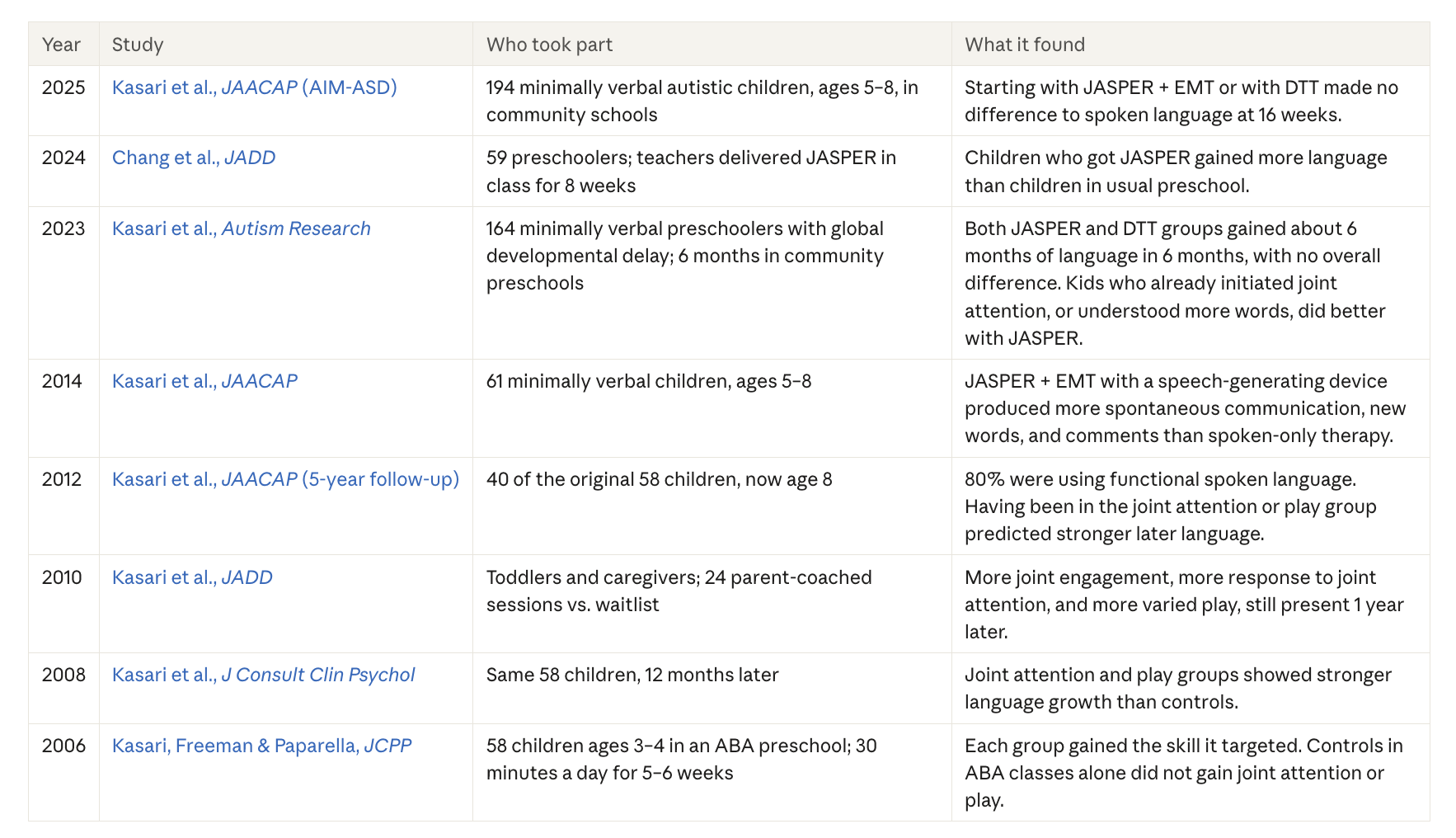
JASPER reliably improves the skills it targets (joint attention, play, and engagement), and its first trial showed language benefits years later. In two recent head-to-head trials, though, it matched discrete trial teaching (DTT) on spoken language rather than beating it. Here are the key studies, newest first.
Some of the strongest benefits for autism
The largest review of early autism interventions, Project AIM in The BMJ, pooled 252 studies and 13,304 children (Sandbank et al., 2023). JASPER belongs to its NDBI category. In randomized trials, NDBIs improved social communication, language, play, and adaptive skills. NDBIs were also the only category with an effect that held up under the review's strictest bias filters.
The same review notes that England's NICE guidance found enough evidence for only two approaches: PACT and JASPER. Traditional behavioral interventions showed randomized-trial benefits mainly for challenging behavior and social-emotional skills, largely based on parent and teacher reports.
JASPER vs. ABA vs. Floortime: how they differ
The biggest difference is who leads. Traditional ABA is mostly adult-led, Floortime is mostly child-led, and JASPER shares control: the child chooses the play, and the adult builds on it. That's how Project AIM defines the three families of approaches (Sandbank et al., 2023).
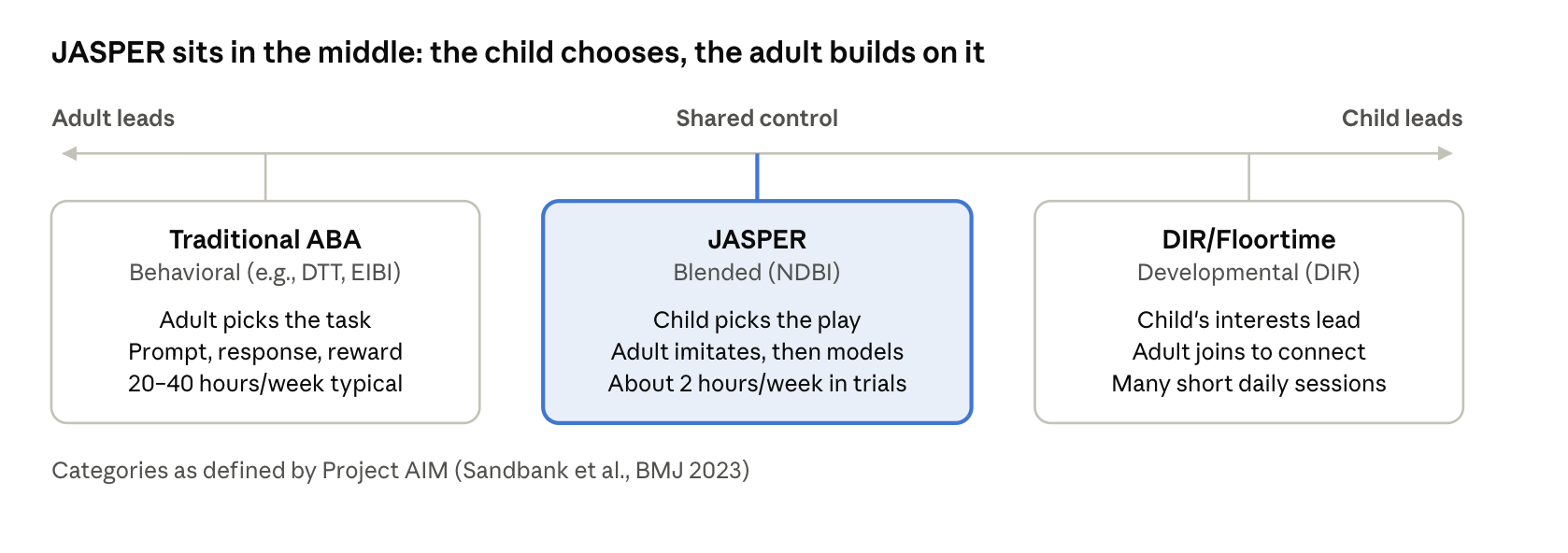
JASPER follows the child's choice of play, but the adult still deliberately teaches the next skill inside it.
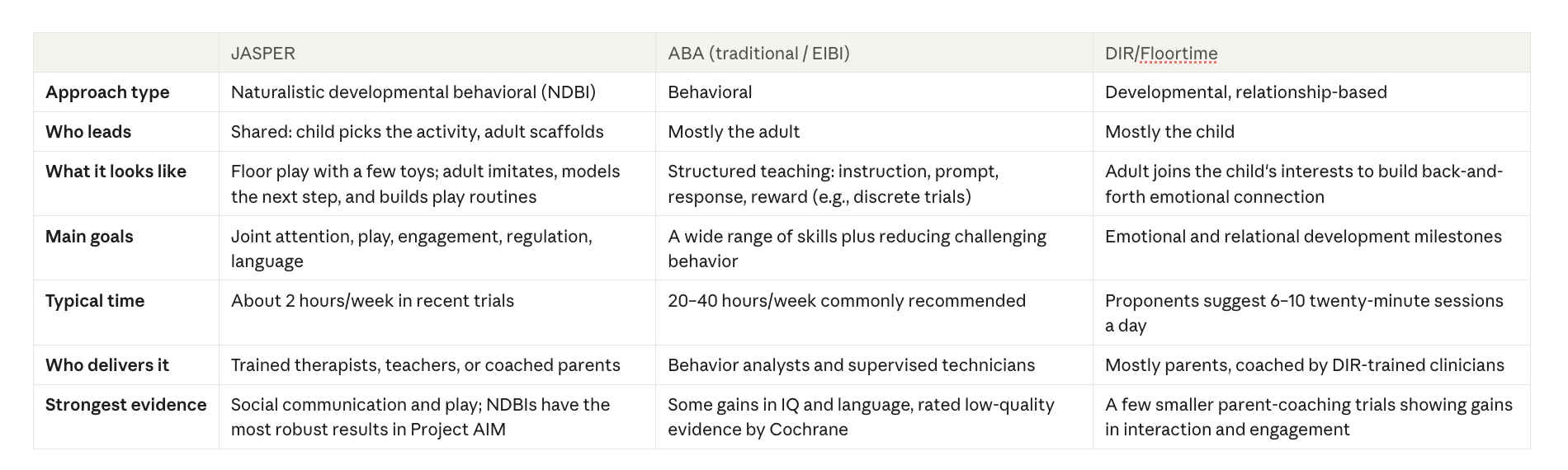
Sources for the table: Sandbank et al., 2023; Reichow et al., Cochrane 2018; ASAT on DIR/Floortime; PRISM trial listing.
A closer look at ABA
Applied behavior analysis (ABA) is the most commonly recommended autism therapy in the U.S., often as early intensive behavioral intervention (EIBI) at 20–40 hours a week (Sandbank et al., 2023). A 2018 Cochrane review found EIBI may raise IQ and language scores, but rated the evidence low quality and found no clear effect on autism symptom severity (Cochrane).
"ABA" also covers a lot of ground today. JASPER itself uses behavioral teaching techniques, and Kasari designed it to slot into existing ABA programs (Autism Speaks). In the 2006 trial, children were already attending an ABA preschool; adding 30 minutes of JASPER-style teaching is what built their joint attention and play.
A closer look at DIR/Floortime
DIR stands for Developmental, Individual-difference, Relationship-based; Floortime is the play technique used to reach its developmental milestones. Families do much of the work, often in many short sessions a day (ASAT).
Its research base is smaller. In a Thai pilot trial, parents added an average of 15.2 hours a week of home Floortime for 3 months, and children gained more on emotional-development and autism-rating measures than controls (Pajareya & Nopmaneejumruslers, 2011). The PLAY Project, a parent-coaching model built on DIR, has also been tested in a randomized trial (Solomon et al., 2014); a review group rates DIR parent training as possibly efficacious (ASAT).
Is JASPER right for your child?
JASPER is a strong first choice when your main goal is social communication, balancing requesting language and social language, and generalization of skills: sharing attention, playing together, and building toward words. It's also low-dose and plays well with other services, so it doesn’t require families to give up ABA, Floortime, speech, etc.
JASPER may be a great fit if
Your child is roughly 1 to 8 years old and still building joint attention, play, or first words.
Your child is minimally verbal; JASPER has been studied with kids who speak few words, including alongside an AAC device.
You want therapy that looks and feels like play rather than drills.
You'd like to learn the strategies yourself; parent-coached JASPER has its own trials.
Your child already gets speech therapy, ABA, or special-education preschool, and you want to add a social communication focus.
You want to balance play with knowing that your child is working toward. JASPER involves communicating therapy goals very clearly with caregivers.
Questions to ask a JASPER provider
Have you completed JASPER training through Kasari's team, and are you certified? (Training is offered through JASPER Training.)
How will you measure my child's progress, and how often will we review it?
How will you coach me to use JASPER strategies at home?
What do you do if my child seems distressed or disengaged?
How is the service billed, and is it covered by my insurance or school district?
The Project AIM authors suggest choosing supports that fit your family's daily routines, and watching for signs of distress in your child or yourself after starting any new therapy (Sandbank et al., 2023).
They also caution against treating "less autistic" as the goal; the aim is skills that make your child's life easier.
Kasari's team runs certification trainings for clinicians throughout the year (JASPER Training). Parents, teachers, clinicians, paraprofessionals, and related service providers can all deliver JASPER (JASPER Education). Make sure that your provider is certified in JASPER versus just trained.
Where to look for a JASPER provider
The JASPER Training website. The UCLA JASPER training website is the best place to find certified providers in your area (JASPER Training).
Your child's current team. Ask your developmental pediatrician, speech therapist, or Early Intervention service coordinator who nearby is JASPER-trained.
Across professions. Speech-language pathologists, occupational therapists, psychologists, and behavior analysts all train in JASPER, so search beyond "autism therapy."
Inside your current program. JASPER is designed to work alongside behavioral therapies, so your ABA or preschool team may already have a trained clinician.
Parent coaching. Because parents can learn JASPER, a provider who coaches you means your child gets practice in everyday play, not just in sessions.
JASPER in Manhattan
If you live on the Upper East Side, or anywhere in Manhattan, we'd love to meet your family. We at Saltwater Speech offers JASPER for children ages 1–8+ in Yorkville, Carnegie Hill, Lenox Hill, and beyond. We service the Upper East side at our office space, as well as select areas of Manhattan, both in-home and in-school.
Nicole Kramer, M.S., CCC-SLP is JASPER-certified through Dr. Kasari's training program. She worked directly with Dr. Kasari’s team at the Center for Autism Research and Treatment at UCLA for 6 years as a JASPER therapist, and has held her certification for 10 years total. Every plan includes JASPER sessions, hands-on parent coaching, and a clear outlook on goals. We happily coordinate with your child's other speech, ABA, and/or school team members.
Ages: 1-8+
Where: In-office on the UES / in-home or in-school in select areas of Manhattan
Insurance and funding: Out-of-network superbills
Get started: Book a free consult
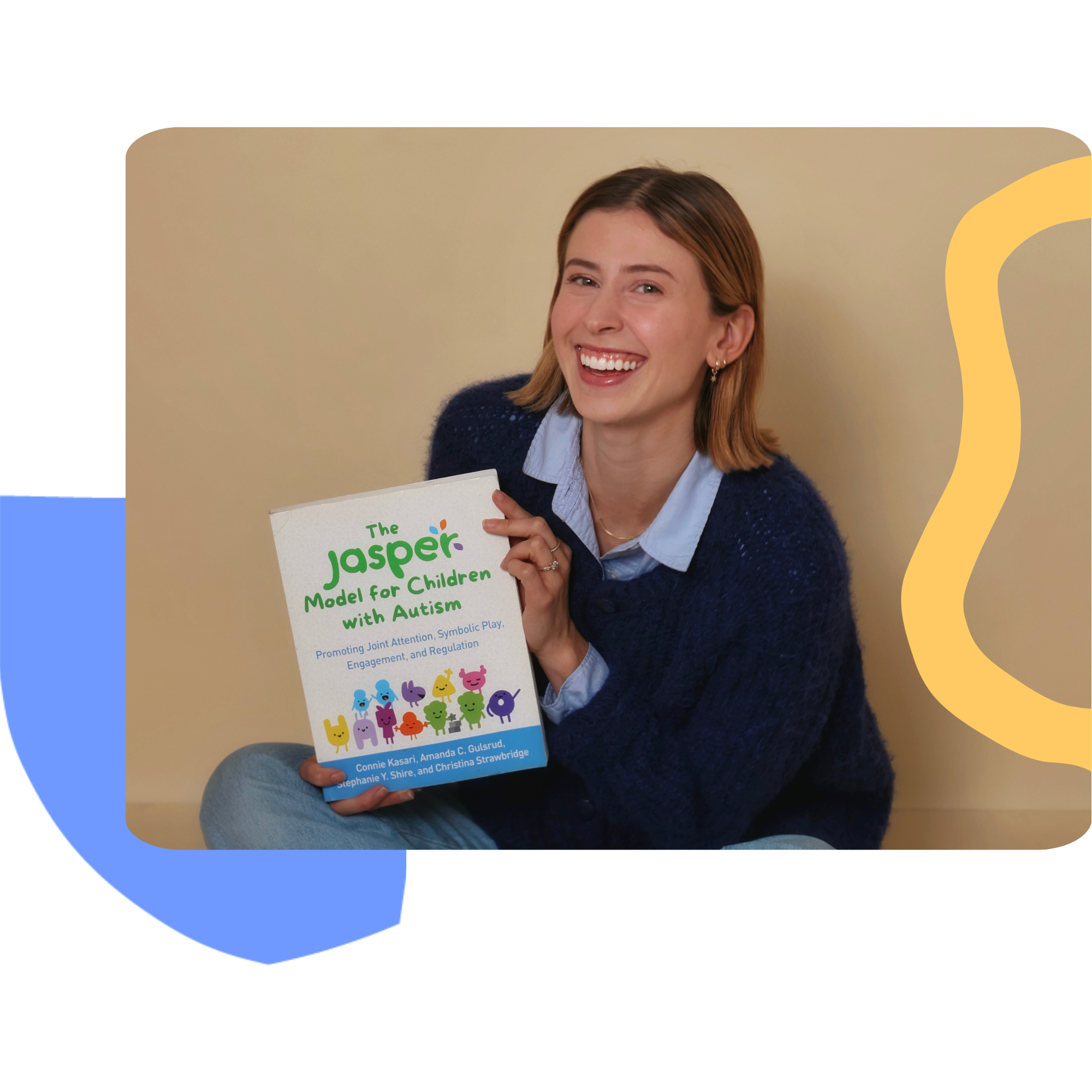
JASPER autism therapy in Manhattan, NYC
Nicole Kramer M.S., CCC-SLP at Saltwater Speech has been certified in JASPER for 10 years.
Frequently asked questions: JASPER autism therapy
What does JASPER stand for?
Joint Attention, Symbolic Play, Engagement, and Regulation. It was developed by Dr. Connie Kasari at UCLA.
Is JASPER a type of ABA?
Not exactly. JASPER is a naturalistic developmental behavioral intervention (NDBI): it blends developmental science with behavioral teaching techniques, inside child-chosen play. It can be added to an existing ABA program.
How many hours a week of JASPER does a child need?
Far fewer than traditional ABA. Recent community trials used about 2 hours a week, and the original trial used 30 minutes a day for 5 to 6 weeks. Parents can extend practice by using JASPER strategies during everyday play.
What age is JASPER for?
The JASPER manual covers children about 1 to 8 years old. Trials have included toddlers, preschoolers, and minimally verbal 5- to 8-year-olds.
Can parents learn JASPER?
Yes. In a randomized trial, toddlers whose caregivers were coached in 24 JASPER sessions showed more joint engagement and more varied play, still present a year later (Kasari et al., 2010).
Does JASPER work for nonverbal or minimally verbal children?
It has been studied specifically with minimally verbal children. Adding a speech-generating device to JASPER plus a language intervention led to more spontaneous communication in 5- to 8-year-olds (Kasari et al., 2014).
Is JASPER better than Floortime?
We found no published trial comparing them directly. However, JASPER has more rigorous randomized trials behind it from UCLA and beyond, while Floortime's evidence comes mostly from smaller parent-coaching studies.
Is JASPER evidence-based?
Yes. The National Clearinghouse on Autism Evidence and Practice lists it as an evidence-based practice, and England's NICE guidance identified it as one of two social communication approaches with sufficient evidence (Sandbank et al., 2023).
How do I find a JASPER provider in NYC?
Look on the JASPER Training website (JASPER Training), ask clinicians directly whether they're JASPER-certified, or ask your Early Intervention coordinator (under 3) or CPSE team (ages 3 to 5) about JASPER-trained providers. On the Upper East Side, Saltwater Speech offers JASPER services with 6 years of direct training at UCLA and 10 years of total of implementing the intervention. Book a free consult.
References
Kasari, C., Freeman, S., & Paparella, T. (2006). Joint attention and symbolic play in young children with autism: A randomized controlled intervention study. Journal of Child Psychology and Psychiatry, 47(6), 611–620. Synopsis (ASAT) · NCAEP entry
Kasari, C., Paparella, T., Freeman, S., & Jahromi, L. (2008). Language outcome in autism: Randomized comparison of joint attention and play interventions. Journal of Consulting and Clinical Psychology, 76(1), 125–137. NICHD summary poster
Kasari, C., Gulsrud, A. C., Wong, C., Kwon, S., & Locke, J. (2010). Randomized controlled caregiver mediated joint engagement intervention for toddlers with autism. Journal of Autism and Developmental Disorders, 40(9), 1045–1056. Link
Kasari, C., Gulsrud, A., Freeman, S., Paparella, T., & Hellemann, G. (2012). Longitudinal follow-up of children with autism receiving targeted interventions on joint attention and play. JAACAP, 51(5), 487–495. Abstract
Kasari, C., Kaiser, A., Goods, K., et al. (2014). Communication interventions for minimally verbal children with autism: A sequential multiple assignment randomized trial. JAACAP, 53(6), 635–646. PubMed
Kasari, C., Shire, S., Shih, W., Landa, R., Levato, L., & Smith, T. (2023). Spoken language outcomes in limited language preschoolers with autism and global developmental delay: RCT of early intervention approaches. Autism Research, 16(6), 1236–1246. Abstract
Chang, Y.-C., Shire, S., Shih, W., & Kasari, C. (2024). Brief report: An exploratory study of young dual language learners with autism receiving JASPER in the classroom. Journal of Autism and Developmental Disorders. Abstract
Kasari, C., Shire, S., Shih, W., Kaiser, A., Lord, C., Levato, L., Smith, T., & Almirall, D. (2025). Adaptive intervention for school-age, minimally verbal children with autism spectrum disorder in the community: Primary aim results. JAACAP, 64(6), 674–685. Full text
Kasari, C., Gulsrud, A. C., Shire, S. Y., & Strawbridge, C. (2021). The JASPER Model for Children with Autism. Guilford Press. Publisher page
Sandbank, M., Bottema-Beutel, K., Crowley LaPoint, S., et al. (2023). Autism intervention meta-analysis of early childhood studies (Project AIM): Updated systematic review and secondary analysis. BMJ, 383, e076733. Full text
Reichow, B., Hume, K., Barton, E. E., & Boyd, B. A. (2018). Early intensive behavioral intervention (EIBI) for young children with autism spectrum disorders. Cochrane Database of Systematic Reviews. Summary
Pajareya, K., & Nopmaneejumruslers, K. (2011). A pilot randomized controlled trial of DIR/Floortime parent training intervention for pre-school children with autistic spectrum disorders. Autism, 15(5), 563–577. Abstract
Solomon, R., Van Egeren, L. A., Mahoney, G., Quon Huber, M. S., & Zimmerman, P. (2014). PLAY Project Home Consultation intervention program for young children with autism spectrum disorders: A randomized controlled trial. Journal of Developmental & Behavioral Pediatrics, 35(8), 475–485. Full text
Association for Science in Autism Treatment. Is there science behind that? DIR/Floortime. Link